Sign In
Sign Up
Select Your Country
 Turkey (Türkçe)
 Worldwide (English)
Turkey (Türkçe)
Worldwide (English)
Turkey (Türkçe)
Worldwide (English)
Worldwide (English)
Turkey (Türkçe)
Worldwide (English)
Turkey (Türkçe)
Worldwide (English)
 WELCOME Kupon Kodunu Kullanarak İlk Siparişlerinize Özel %10 İndirim İmkanından Faydalanabilirsiniz.
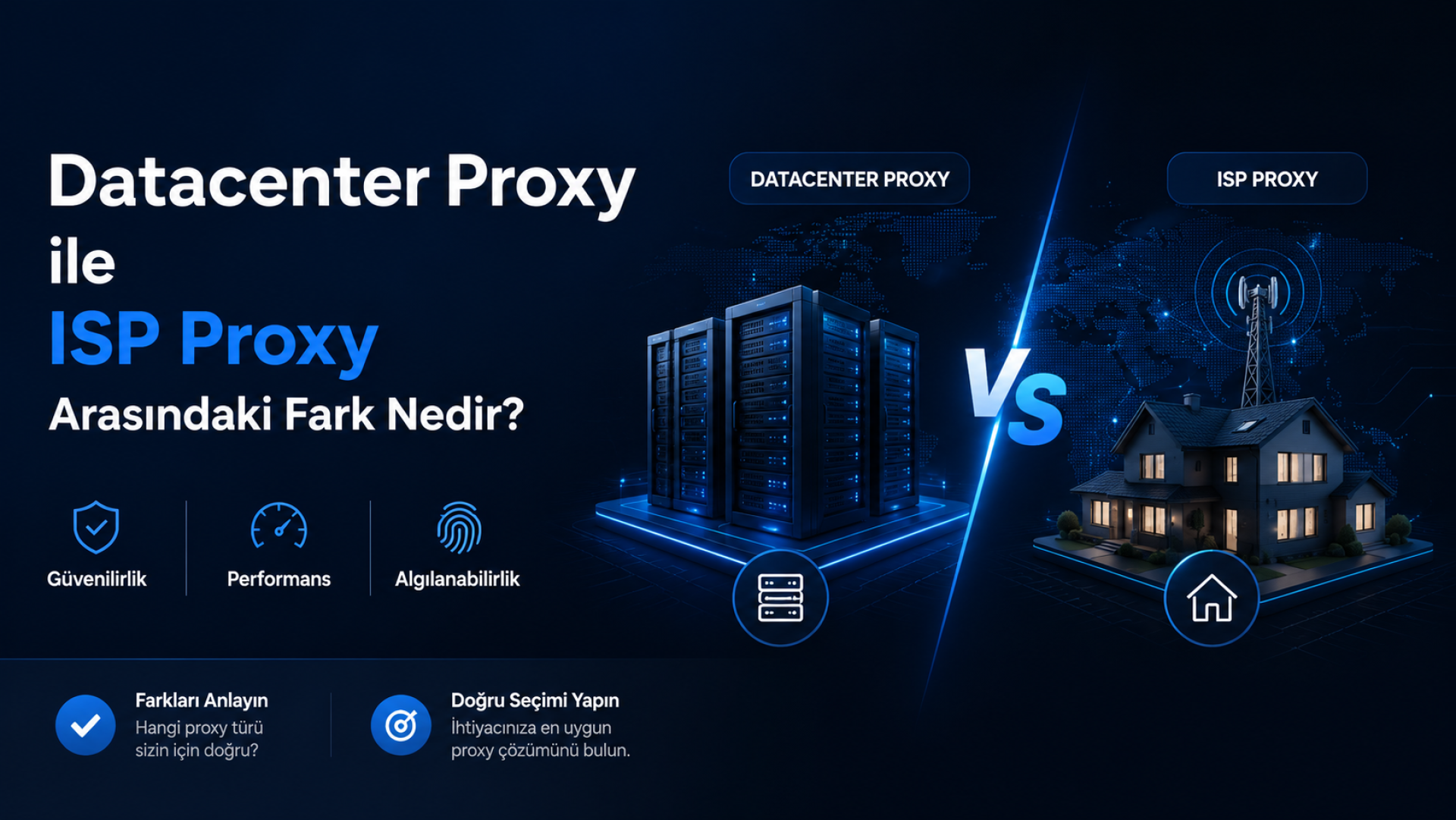
A data center proxy is an intermediary connection that routes internet traffic through an IP address assigned to a server in a data center. These IP addresses are registered directly to the hosting company, not to a GSM carrier or an internet service provider. An ISP proxy (Internet Service Provider proxy, a proxy sourced from an internet service provider) is a hybrid structure that lives in a data center but uses an IP address registered in the name of a real service provider. As of 2026, LivaProxy offers both types from the same panel: Datacenter IPv4 Proxy starts at 50 TL, and ISP IPv4 Proxy starts at 100 TL.
LivaProxy is a proxy service provider with the trade name LIVAPROXY YAZILIM TİCARET LİMİTED ŞİRKETİ and headquarters in İstanbul Sultangazi. The company's Trade Registry No 43944 and Mersis No 0609126984500001 are published openly on the site. Both proxy types run on the IPv4 protocol, meaning they use the addressing system that defines internet addresses in the classic four block format (for example, 192.0.2.1).
The main difference is who the IP address is registered to. In a data center proxy, the IP is tied to the hosting company's autonomous system number (ASN, the identifier that names a network operator), and websites easily recognize this as data center origin. In an ISP proxy, the same server physically sits in the data center, but the IP it uses is allocated from an internet service provider's block. Because of this, the target site tends to interpret the IP as a home or business subscriber.
The second distinction is perceived legitimacy. Because data center IPs are produced in bulk and at low cost, some platforms monitor these blocks more closely. ISP IPs come from a real subscriber block, so they attract less attention on the same platforms. The third distinction is cost: in LivaProxy pricing, the ISP IPv4 package (100 TL) starts at twice the data center IPv4 package (50 TL).
Because both types are hosted on data center infrastructure, connection speed stays in the high range. A data center proxy has low latency when bound to shared server resources. The ISP proxy uses the same data center backbone, so the speed difference is not noticeable in most scenarios. The real difference is not in speed but in how the IP is classified by the target platform.
The table below puts the two proxy types side by side based on LivaProxy catalog data and technical attributes. Prices belong to the starting packages and are the current values published on the site.
A data center proxy is suited for high volume and cost sensitive operations. Its low starting price (50 TL) and high speed stand out in work that requires many concurrent requests. An ISP proxy is preferred in work where it matters that the IP appears more natural. The LivaProxy category offers this hybrid structure over a static IP.
The list below summarizes the typical scenarios where the two types diverge:
Data collection and web scraping: data center proxy stands out with its cost and speed advantage.
Social media account management: ISP proxy faces fewer limits thanks to its subscriber IP perception.
Automation and test environments: data center proxy provides many IPs at low cost.
Long term static sessions: ISP proxy provides session continuity with its static IP structure.
A third distinction is the need for IP renewal. For both types, the LivaProxy panel supports the IP authorization (whitelist) method, meaning the practice of defining access permission for a specific IP. Data center packages are usually configured around a wider IP pool logic, while ISP packages are configured with a stability expectation.
The first criterion in selection is the platform sensitivity of the job. If the target site closely monitors data center IPs, the ISP proxy delivers more stable results. The second criterion is budget: in the LivaProxy catalog, the data center entry package is at 50 TL, and the ISP entry package is at 100 TL. The third criterion is protocol compatibility; both types support HTTP/HTTPS and SOCKS5 protocols, so they are compatible with most software tools.
Before making a choice, these items can be checked:
The number of concurrent IPs and total request volume the job requires.
How the target platform handles data center IPs.
Whether a static IP or a rotating IP from a pool is needed.
Monthly budget and cost per IP unit.
Data center proxy and ISP IPv4 proxy use the same IPv4 backbone, but the IP's registration source determines the outcome of the job. The data center proxy, with a 50 TL starting price, stands out for high volume data collection and test work where cost and speed are the priority. The ISP proxy, with a 100 TL starting price, is more stable for sensitive platform access where it is valuable for the IP to appear as a subscriber. LivaProxy offers both types from the same panel with HTTP/HTTPS and SOCKS5 protocol support and IP authorization management. The decision is made based on the balance between speed and cost on one side and perceived legitimacy on the other.
This content is for informational purposes. Prices and package contents may change; verify current information from the official LivaProxy site before purchase.
A data center proxy is an intermediary connection that routes internet traffic through an IP address registered to a server in a data center. The IP is registered to the hosting company, not to an internet service provider. It provides high speed and low cost; in the LivaProxy catalog, the data center IPv4 package starts at 50 TL and supports HTTP/HTTPS and SOCKS5 protocols.
ISP proxy uses addresses allocated from the IP block of a real internet service provider. The sourcing of these addresses and their subscriber like interpretation raises the cost. At LivaProxy, the ISP IPv4 package starts at 100 TL and the data center IPv4 package starts at 50 TL; so the ISP entry price is twice that of data center.
Because data center and ISP proxies are hosted on the same data center infrastructure, the speed difference is not noticeable in most scenarios. The real distinction is not in speed but in whether the IP is classified by the target platform as a data center or a subscriber connection. Both types operate at high bandwidth.
A data center proxy offers cost and speed advantages in high volume data collection, automation, and test work. An ISP proxy is more stable in social media account management and sensitive platform access where it matters that the IP appears as a subscriber. The choice is made based on the platform sensitivity of the job and the budget.
LivaProxy offers Datacenter IPv4 Proxy (from 50 TL), ISP IPv4 Proxy (from 100 TL), IPv6 Proxy, Rotating IPv6 Proxy, and mobile proxy packages from the same panel. All IPv4 products support HTTP/HTTPS and SOCKS5 protocols and IP authorization management. The company is headquartered in İstanbul Sultangazi, and Trade Registry No 43944 is published on the site.