Sign In
Sign Up
Select Your Country
 Turkey (Türkçe)
 Worldwide (English)
Turkey (Türkçe)
Worldwide (English)
Turkey (Türkçe)
Worldwide (English)
Worldwide (English)
Turkey (Türkçe)
Worldwide (English)
Turkey (Türkçe)
Worldwide (English)
 WELCOME Kupon Kodunu Kullanarak İlk Siparişlerinize Özel %10 İndirim İmkanından Faydalanabilirsiniz.
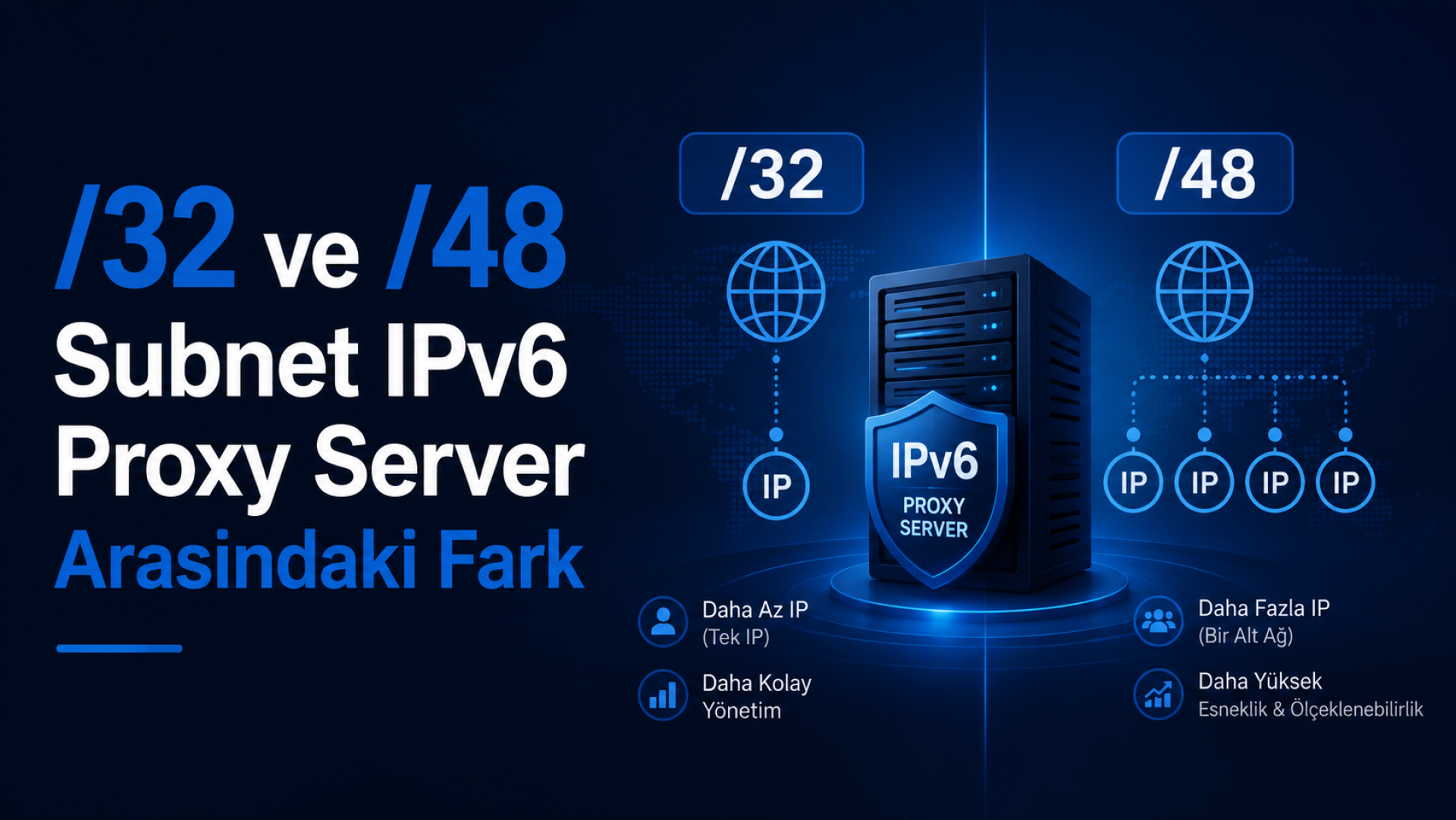
A subnet IPv6 proxy server is a proxy structure that provides many different IP addresses from within a single IPv6 address block (subnet). IPv6 (Internet Protocol version 6) is the internet protocol that assigns a unique address to each device and uses a 128 bit address space. LivaProxy offers two packages in this category: /48 subnet and /32 subnet. The /48 package starts at 1,500 TL, and the /32 package starts at 4,250 TL. LIVAPROXY YAZILIM TİCARET LİMİTED ŞİRKETİ provides this service over its Turkey based infrastructure through its own website.
Subnet notation is based on a system called CIDR (Classless Inter-Domain Routing). In this notation, the number after the slash shows how many bits of the address are fixed (the network portion). The /48 notation means the first 48 bits are fixed and the remaining 80 bits are free for IP generation. The /32 notation fixes only the first 32 bits and leaves 96 bits free. As the number of fixed bits decreases, the block grows, which means the number of unique IPs that can be generated increases.
The difference between /32 and /48 subnets comes from the size of the block. A /32 is a larger address block, and a /48 is a smaller section within it. The 16 bit difference between them changes block capacity by a factor of 65,536. In practice, this means the /32 package provides a much larger IP pool. In LivaProxy pricing, this capacity difference shows up as a 1,500 TL starting point for /48 and a 4,250 TL starting point for /32.
Block size translates directly into rotation flexibility in proxy use. A wide block lets you work with IP addresses that do not repeat back to back in the same project. This difference becomes clear in large scale account management or heavy data collection operations. For a single account or low volume use, the capacity gap between the two packages is usually larger than necessary.
Both packages share the same protocol support: HTTP/HTTPS proxy and SOCKS5 (Socket Secure version 5, a connection protocol that carries application traffic). The difference is not in technical features but in block width and the resulting cost. In the LivaProxy product family, IPv6 proxy services range from the basic package starting at 200 TL all the way up to the /32 subnet server.
The table below shows the technical and commercial differences between the two packages side by side. The data is based on the starting prices published in the LivaProxy product catalog and on the standard definition of CIDR notation.
Subnet size determines how broad an IP variety a proxy project can work with. A narrow block offers a limited number of unique IPs that can run out quickly. A wide block lowers how often the same IP shows up again. This variety reduces the likelihood that target platforms will associate requests coming from the same source.
IP repeat frequency creates a practical threshold in automation and account management scenarios. A user opening many parallel sessions will cycle through IPs quickly in a narrow block. In a wide block, each session can land in a different address range. As volume grows, subnet width becomes a more decisive criterion than cost.
The /48 subnet IPv6 proxy server is positioned for users with mid sized IP variety needs. With a 1,500 TL starting price, it offers a more accessible premium entry point compared to the /32 package. This package targets users who manage a limited number of accounts or perform medium intensity data collection.
Typical use cases for this segment include:
Medium intensity management of multiple social media accounts
Mid volume web scraping (web data collection) tasks
Automation work that requires a limited number of parallel sessions
Enterprise users who want to test the premium IPv6 structure
The /48 package serves as a stepping stone for users who want to experience the benefits of a wide IPv6 block without committing to the highest package cost. For lower volume needs, the LivaProxy standard option starting at 200 TL also provides the same protocol support.
The /32 subnet IPv6 proxy server is designed for high use scenarios that demand the broadest IP variety. With a 4,250 TL starting price, it is the top premium package in the LivaProxy product family. It offers an address block 65,536 times wider than the /48 and is built for large scale operations.
The intensive user profiles this package serves include:
Enterprise teams managing hundreds of parallel accounts
High volume and continuous data collection infrastructures
Large automation systems that require wide IP rotation
Projects where IP repetition creates operational risk
The wide block of the /32 package makes it possible to work with IPs that do not repeat over long periods within the same project. This capacity advantage is more than necessary for low volume use, and the cost difference loses its justification in that case. Package selection depends on the scale of the capacity need.
The choice between /32 and /48 comes down to the balance between a project's IP variety need and budget. The /48 package, with a 1,500 TL starting price, meets mid volume needs and provides an accessible entry into the premium IPv6 structure. The /32 package, at 4,250 TL, offers the widest block and makes sense for high volume, multi session operations. Since both packages share the same protocols (HTTP/HTTPS, SOCKS5), the difference is not in technical features but in capacity and cost.
Three practical thresholds stand out for the decision. At low and medium volumes, /48 is sufficient and the extra capacity of /32 sits idle. At high parallel session counts, the /48 block cycles quickly and the width of /32 becomes the decisive factor. If cost is the priority, the 1,500 TL /48 is the logical choice; if capacity is the priority, the 4,250 TL /32 makes sense. The decision comes down to a preference between capacity and cost priority.
This content is for informational purposes. Prices and package contents may change; verify current information from the official seller page before purchase.
A subnet IPv6 proxy server is a proxy structure that provides many unique IP addresses from within a single IPv6 address block. The block size is specified using CIDR notation (for example, /32, /48). LivaProxy offers two premium packages in this category, /48 and /32, and both support HTTP/HTTPS and SOCKS5 protocols.
The main difference is block size. The /32 package offers an IP pool 65,536 times wider than the /48 package. This is because the /32 has fewer fixed bits (32). A wider block provides more unique IPs and a lower repeat frequency; protocol support is the same in both packages.
The /48 subnet IPv6 proxy server is the more affordable option with a 1,500 TL starting price. The /32 subnet package starts at 4,250 TL and is the top premium package in the LivaProxy product family. The price difference reflects the much larger IP block capacity that /32 provides.
The /32 subnet is better suited for high volume use. Its wide block lowers the frequency of IP repetition across many parallel sessions. The /48 package is sufficient for mid volume needs; in very heavy and continuous operations, the extra capacity of /32 becomes a decisive advantage.
Yes, both the /48 and /32 subnet IPv6 proxy server packages support HTTP/HTTPS proxy and SOCKS5 protocols. The difference is not in the protocol feature but in the IP block size and the resulting capacity and price level. Package selection comes down to capacity need, not technical compatibility.