Sign In
Sign Up
Select Your Country
 Turkey (Türkçe)
 Worldwide (English)
Turkey (Türkçe)
Worldwide (English)
Turkey (Türkçe)
Worldwide (English)
Worldwide (English)
Turkey (Türkçe)
Worldwide (English)
Turkey (Türkçe)
Worldwide (English)
 WELCOME Kupon Kodunu Kullanarak İlk Siparişlerinize Özel %10 İndirim İmkanından Faydalanabilirsiniz.
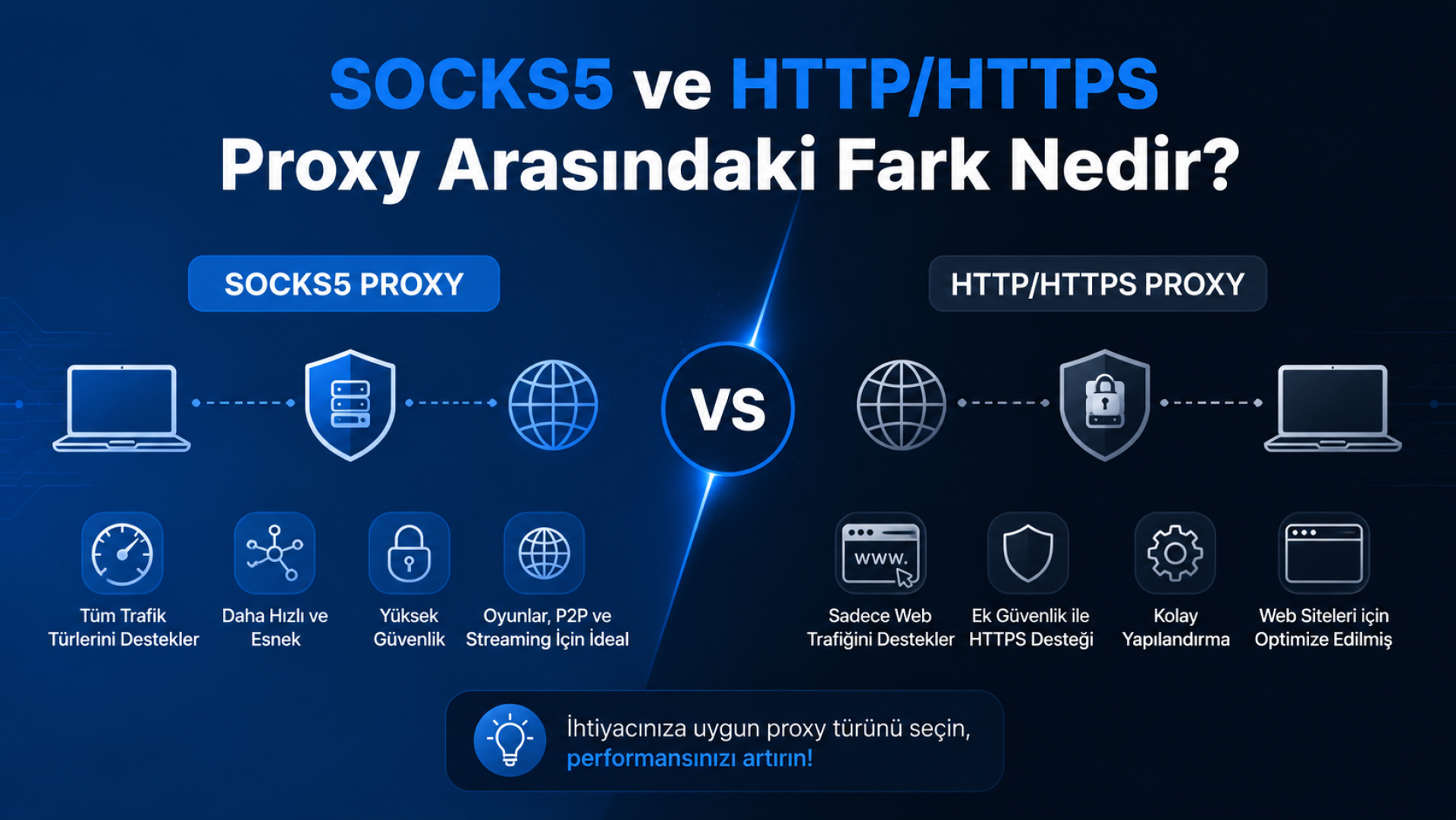
SOCKS5 and HTTP/HTTPS proxy are two different proxy protocols that route internet traffic through an intermediary server. A proxy is the intermediary server that sits between the user and the target server and forwards the request in place of the user. HTTP/HTTPS proxy works at layer 7 (the application layer) and only understands web traffic. SOCKS5 works at layer 5 (the session layer) and carries any traffic regardless of protocol type.
LivaProxy is the brand of LIVAPROXY YAZILIM TİCARET LİMİTED ŞİRKETİ, which provides Turkey based proxy services. The company's mobile proxy packages support both protocols: the package features include both HTTP/HTTPS proxy and SOCKS v5 proxy. For this reason, a user can use both protocols with a single package and choose based on the use case.
The main difference between SOCKS5 and HTTP/HTTPS proxy is the network layer they operate on and the type of traffic they carry. Because HTTP/HTTPS proxy can read the content of the request, it is efficient only for web pages, file downloads, and browser based operations. SOCKS5 does not look at the content of the request and forwards the packet as is; for this reason, it is also compatible with non web protocols such as gaming, peer to peer (P2P) connections, email, and custom application traffic.
Traffic type is the first point where these two protocols diverge. HTTP proxy handles unencrypted web traffic, and HTTPS proxy handles encrypted (TLS) web traffic. SOCKS5 can carry both UDP (the connectionless fast data transmission protocol) and TCP (the connection based reliable transmission protocol) traffic. This breadth makes SOCKS5 a more flexible, general purpose protocol.
HTTP/HTTPS proxy works at the application layer of the OSI model. The OSI model is a standard reference framework that divides network communication into 7 layers. Because the application layer sees the content of the request, the proxy can read header information and perform caching (the temporary storage of frequently accessed data). SOCKS5 works at the session layer; it does not interpret the data and only forwards it.
SOCKS5 and HTTP/HTTPS proxy are compared on six criteria in the table below. The table provides a quick reference showing which protocol is more suitable for which job.
SOCKS5 proxy is preferred for jobs that require non web traffic. Because it forwards raw packets without reading the content, it works compatibly with game connections, peer to peer file sharing, email clients, and custom automation tools. Among LivaProxy's target audience are customers who use social media management, gaming, data collection (web scraping), and automation; a significant portion of these scenarios rely on the general purpose structure of SOCKS5.
The cases below are typical use examples where SOCKS5 stands out:
Online game traffic and connections that require low latency.
Peer to peer (P2P) file sharing clients.
Non browser automation and data collection tools.
Email sending and receiving protocols (SMTP, IMAP).
HTTP/HTTPS proxy is preferred when the entire job is web based. Because it can read the request header, it provides filtering, caching, and content level control over web requests. HTTPS proxy is suited for secure sessions such as banking, login screens, and sensitive form submissions, since it carries traffic encrypted with TLS (Transport Layer Security). All browser based operations run with this protocol at a low configuration cost.
The distinction between HTTP and HTTPS proxy is also important. HTTP proxy establishes an unencrypted connection, and the data is sent in the clear. HTTPS proxy, with the CONNECT method, opens an encrypted tunnel, so it is the secure standard of today's web traffic. In web focused use, HTTPS is prioritized over the two protocols.
LivaProxy mobile proxy packages support both HTTP/HTTPS proxy and SOCKS v5 proxy protocols in a single package. Package features also include IP authorization (whitelist), IP reset link, and automatic IP reset. This structure allows the user to switch protocols based on the job, meaning to run both web and non web scenarios with the same subscription.
The company's product range is not limited to mobile proxy. The category is a separate entry point for datacenter and ISP based options. The table below lists the main product categories with their starting prices.
The lowest entry cost is in the Datacenter IPv4 package (50 TL). The top package is the /32 subnet IPv6 server (4,250 TL). This wide price range offers options for both individual and corporate segments with different protocol and volume needs.
The choice between SOCKS5 and HTTP/HTTPS proxy depends on whether the job is web or non web. SOCKS5 is general purpose: it provides broad compatibility with gaming, peer to peer sharing, automation, and non web protocols. HTTP/HTTPS proxy is web focused: it is efficient in browser based work for caching, content filtering, and secure (HTTPS) sessions.
The practical decision clarifies on three points. If you are carrying non web application traffic, the SOCKS5 protocol is more compatible. If only web page access is needed, HTTPS proxy offers a low configuration cost. Because LivaProxy mobile packages include both in a single subscription, the user can switch protocols by scenario with one product; the starting price is at 1,400 TL monthly.
This content is for informational purposes. Prices and package features may change; verify current information from the official seller page before purchase.
SOCKS5 proxy is a proxy protocol that routes internet traffic at the session layer. It does not read the content of the request and forwards the packet as is. For this reason, it carries both TCP and UDP traffic and works compatibly with non web scenarios such as gaming, peer to peer sharing, and automation. LivaProxy mobile proxy packages support the SOCKS v5 protocol.
HTTP proxy forwards web traffic unencrypted, and the data is sent in the clear. HTTPS proxy, with the CONNECT method, establishes an encrypted tunnel and carries traffic protected by TLS (Transport Layer Security). HTTPS proxy is preferred in secure sessions such as login screens, payment, and sensitive form submissions.
Speed depends on the use case. SOCKS5 is advantageous in non web jobs and those requiring low latency because it forwards raw packets without reading the content. HTTP/HTTPS proxy, because it can perform caching, can provide extra speed on frequently accessed web pages. A single protocol is not faster in every situation.
Yes, LivaProxy mobile proxy packages include both HTTP/HTTPS proxy and SOCKS v5 proxy protocols in the same subscription. The user can switch protocols based on the type of job. Package features also include IP authorization, IP reset link, and automatic IP reset.
At LivaProxy, both protocols come with the mobile proxy packages. The monthly mobile proxy starting price is 1,400 TL (Economy 15GB). Datacenter IPv4 proxy starts at 50 TL, and ISP IPv4 proxy starts at 100 TL. The wide price range offers different volume options for individual and corporate users.