Sign In
Sign Up
Select Your Country
 Turkey (Türkçe)
 Worldwide (English)
Turkey (Türkçe)
Worldwide (English)
Turkey (Türkçe)
Worldwide (English)
Worldwide (English)
Turkey (Türkçe)
Worldwide (English)
Turkey (Türkçe)
Worldwide (English)
 WELCOME Kupon Kodunu Kullanarak İlk Siparişlerinize Özel %10 İndirim İmkanından Faydalanabilirsiniz.
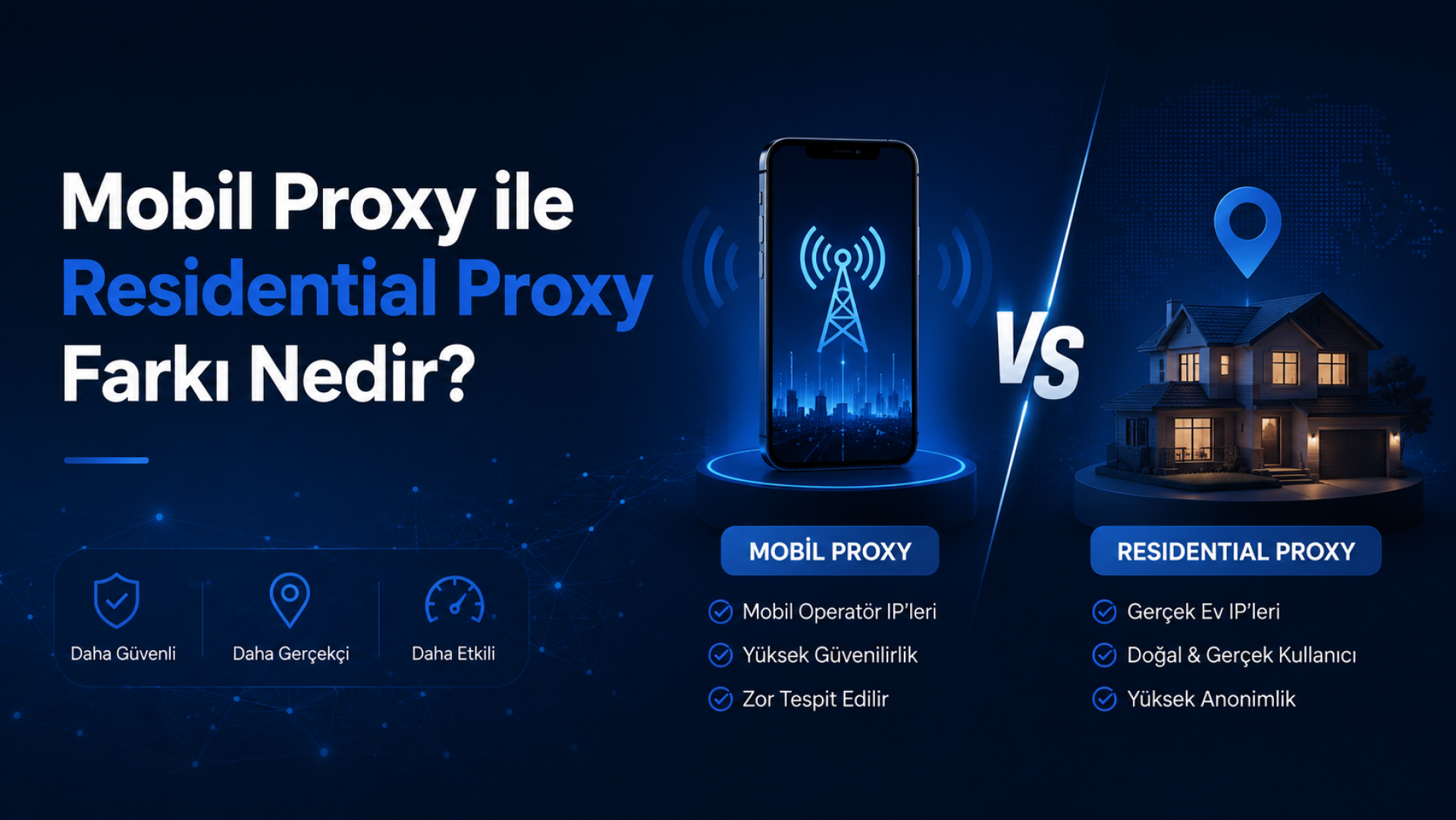
A mobile proxy is a type of intermediary server that routes internet traffic through an IP address assigned by a real mobile carrier line. LivaProxy provides its Turkey based mobile proxy service over carrier infrastructure and offers its main product, monthly packages, starting at 1,400 TL. A residential proxy is another type of intermediary that uses fixed line IP addresses (DSL, fiber) belonging to home users. Both structures hide the user's real exit IP address and make them appear to the target site as a carrier or home user. The main distinction is in the IP source: a mobile proxy takes its IP from a 4G/5G carrier line, while a residential proxy takes its IP from a home internet line.
LivaProxy operates under the trade name LIVAPROXY YAZILIM TİCARET LİMİTED ŞİRKETİ and is registered with Mersis No 0609126984500001. The service catalog covers data center IPv4, ISP IPv4, IPv6, and subnet IPv6 proxy products in addition to mobile proxy. This article explains the often confused distinction between mobile and residential proxy at the level of technical source, cost, and use case.
IP source is the most defining feature that separates one proxy type from another. A mobile proxy uses addresses from the IP pool that the GSM carrier (the company that provides cell phone service) distributes to its subscribers. These IP addresses are shared with thousands of real subscribers due to the carrier's CGNAT (Carrier-Grade Network Address Translation, carrier level address translation) structure. When a target site blocks one of these addresses, it carries the risk of also blocking many real users in the same block, so mobile IP blocks are generally blocked less often and more cautiously.
A residential proxy uses fixed line IP addresses that the internet service provider (ISP) assigns to home subscribers. Because these addresses are tied to a single household, their geographic location precision is high, but they lack the crowded appearance that carrier shared IPs provide. Rotation, meaning IP renewal behavior, also differs: a mobile proxy can pick up a new IP through a reset link tied to the line, while in residential pools renewal usually happens by switching to a different home IP within the pool.
The table below puts the two proxy types side by side in terms of technical source, IP renewal, and typical use. The data is based on general proxy architecture and the LivaProxy mobile proxy package features.
Mobile proxy packages in the LivaProxy catalog are built around IP management and protocol flexibility. The monthly packages start at the 15GB Economy level and continue with 30GB Medium and higher packages. The traffic based (GB) structure lets the user choose a package based on monthly data consumption. For short term needs, the weekly package is offered at 700 TL and the daily package at 225 TL starting price.
Mobile proxy packages include these technical features:
IP Authorization (whitelist, defining permitted IPs)
IP Reset Link and Automatic IP Reset
HTTP/HTTPS Proxy protocol support
SOCKS v5 Proxy support
Turkey based exit IP (İstanbul and Bursa)
The Bursa location went on sale for mobile proxy service in 2026 and provided an additional exit point alongside the İstanbul Sultangazi headquarters. This multi location structure offers access to different cell tower IPs without being tied to a single carrier block.
A residential proxy stands out in scenarios that require a fixed IP tied to a single household. In jobs where the geographic location needs to be verified at the household level, for example city specific price or stock tracking, the residential IP gives a more stable location signal. This structure lacks the crowded sharing of carrier IPs, so it can be preferred in session based work that wants behavioral continuity.
A mobile proxy provides an advantage in work where blocking resistance is more important than session stability. In social media account management, automation, and gaming scenarios, the carrier IP blending with real subscriber traffic lowers the likelihood of being blocked. The LivaProxy catalog is focused on mobile proxy; residential proxy is explained here as a general category for comparison purposes, not as a product belonging to the company.
Cost is a decisive criterion in choosing a proxy type. The LivaProxy price range starts at 50 TL for data center IPv4 proxy and stretches to 4,250 TL for the premium /32 Subnet IPv6 Proxy Server. This wide band targets both individual test users and enterprise customers. The monthly mobile proxy package, at 1,400 TL, is positioned in the mid upper segment.
The list summarizing cost bands:
Datacenter IPv4: from 50 TL (lowest entry cost)
ISP IPv4: from 100 TL
IPv6: from 200 TL
Daily mobile proxy: from 225 TL
Monthly mobile proxy: from 1,400 TL (15GB)
Rotating IPv6: from 1,250 TL (different IP on every request)
The WELCOME coupon code for the first order provides a 10% discount published on the site. The cost difference between data center and residential architecture typically comes from sourcing difficulty: because home line IPs are harder to gather than carrier IPs, they are usually positioned at a higher price in the market.
The choice between mobile proxy and residential proxy depends on whether the work requires blocking resistance or location stability. A mobile proxy stands out in jobs that are resistant to blocking thanks to the crowded sharing of GSM carrier IPs, and in Turkey based social media and automation scenarios. LivaProxy offers mobile proxy packages with İstanbul and Bursa exits in this area starting at 1,400 TL.
A residential proxy is valuable in data collection jobs that want household level location precision and stable IP continuity. Three core findings clarify the decision: the IP source is the carrier line in mobile and the home subscription in residential; blocking resistance is high in mobile thanks to the crowded block effect; cost is generally higher in the residential architecture. If a Turkey IP and carrier infrastructure are your priority, the mobile proxy structure directly answers that demand.
This content is for informational purposes; prices, package contents, and location coverage may change. Verify current information from the official seller page before purchase.
The main difference is in the IP source. A mobile proxy uses an IP from a GSM carrier's 4G/5G line, and these addresses are shared with thousands of subscribers through the CGNAT structure. A residential proxy uses fixed line IP addresses that the internet service provider assigns to home subscribers. The mobile structure is more resistant to blocking thanks to crowded sharing, while the residential structure is more stable for household level location precision.
LivaProxy offers its Turkey based mobile proxy service over carrier infrastructure, and this is the main product in the catalog. Monthly mobile proxy is provided starting at 1,400 TL with İstanbul and Bursa exit locations. The catalog also covers data center IPv4, ISP IPv4, and IPv6 proxy products. Residential proxy is described in this article as a general category.
LivaProxy mobile proxy packages are priced by usage duration. The monthly Economy 15GB package is offered at a starting price of 1,400 TL. For short term needs, the weekly package starts at 700 TL and the daily package starts at 225 TL. Packages are configured on a traffic (GB) basis and continue with 30GB Medium and higher levels. The WELCOME coupon code provides a 10% discount on the first order.
LivaProxy mobile proxy packages support HTTP/HTTPS Proxy and SOCKS v5 Proxy protocols. Packages also include IP Authorization (whitelist), IP Reset Link, and Automatic IP Reset features. This structure lets the user define authorized IPs and renew the exit IP when needed. The Turkey based exit IP is provided from the İstanbul and Bursa points.
A mobile proxy is suited for social media management, automation, and gaming scenarios where blocking resistance is the priority, because the carrier IP blends with real subscriber traffic. A residential proxy is preferred in data collection, price tracking, and similar jobs that want household level location precision and stable IP continuity. The choice depends on whether the work requires location stability or blocking resistance.