Sign In
Sign Up
Select Your Country
 Turkey (Türkçe)
 Worldwide (English)
Turkey (Türkçe)
Worldwide (English)
Turkey (Türkçe)
Worldwide (English)
Worldwide (English)
Turkey (Türkçe)
Worldwide (English)
Turkey (Türkçe)
Worldwide (English)
 WELCOME Kupon Kodunu Kullanarak İlk Siparişlerinize Özel %10 İndirim İmkanından Faydalanabilirsiniz.
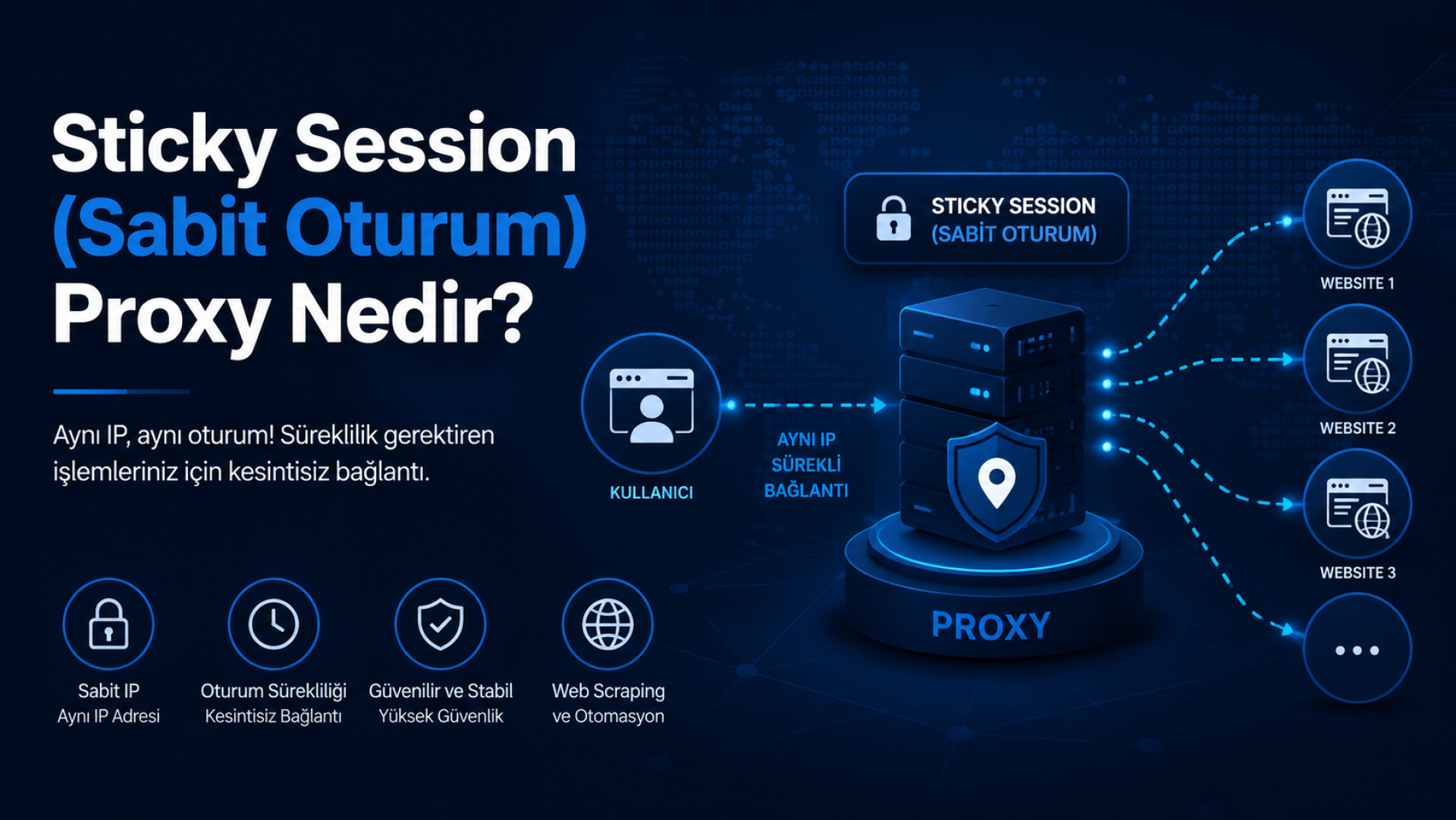
A sticky session proxy is a proxy configuration that assigns the same IP address to a user for a defined period of time. A sticky session, that is the IP staying unchanged until a connection is closed or the defined duration ends, is used in jobs that require session consistency. LivaProxy manages the sticky session logic in its Turkey based mobile proxy service through IP authorization and the IP reset link. Turkey based mobile proxy packages are offered at a starting price of 1,400 TL/month with 15GB of traffic. This proxy type supports HTTP/HTTPS and SOCKS5 protocols and is preferred in scenarios such as social media management, gaming, and data collection.
A proxy is the intermediary server that sits between the user and the target site. The sticky session configuration provides for the IP to be fixed on this intermediary server throughout the session. The LivaProxy panel includes automatic IP reset and a manual reset link, meaning the user can move the session to a new IP at any time. This structure allows the user to control when the IP changes.
The difference between sticky session and rotating proxy is the frequency at which the IP address changes. A sticky session preserves the same IP for a defined period; a rotating proxy assigns a new IP on every request or at short intervals. Both logics exist in the LivaProxy product family: mobile proxy packages offer sticky session management, while Rotating IPv6 Proxy starts at 1,250 TL with the logic of a different IP on every request. The two approaches serve different needs.
Rotating proxy is suited for wide data collection over many IPs and high volume request distribution. Sticky session, on the other hand, stands out in operations that require a single identity to be preserved throughout the session. The table below shows the main distinction between the two structures.
A sticky session proxy works by binding the user's connection to a single IP address. When the user connects to the proxy, the system assigns them an IP, and this IP is preserved until the session duration ends or a reset is triggered. LivaProxy manages this process with IP authorization (whitelist): connections on the authorized IP list access the defined session. From the target site's perspective, all requests appear to come from a single, consistent source.
Session control runs on two layers. The first layer is automatic IP reset, and the second layer is the user triggered manual reset link. In the mobile proxy structure, the IP is assigned over carrier infrastructure, meaning traffic is carried over a real mobile network. This working logic offers session stability together with IP renewal flexibility.
The three main steps of sticky session configuration are as follows:
The user defines their connection in the panel through IP authorization.
The system assigns a fixed IP to the session, and this IP is preserved throughout the duration.
When needed, a switch to a new IP is made through manual reset or automatic reset.
A sticky session proxy is used in social media management because it preserves session security. Social media platforms can evaluate IPs that change frequently in a short period as suspicious behavior. A sticky session reduces this inconsistency by allowing an account to operate over a single IP throughout the session. LivaProxy's Turkey based IPs provide geographic consistency in social media work aimed at local audiences.
For teams managing multiple accounts, it is important that each account connects to a separate, fixed IP. This separation prevents the mixing of IPs across accounts. LivaProxy's carrier infrastructure packages support this session separation through real mobile network IPs. Mobile network IPs carry a profile closer to everyday user traffic compared to data center IPs.
The prominent use areas of the sticky session structure in social media are:
Assigning a fixed IP to each account in multi account management.
Maintaining login state without interruption throughout the session.
Local campaign work that requires a Turkey location.
Providing session stability in automation tools.
The most common misconception about sticky session proxy is the thought that the IP stays fixed forever. A sticky session is valid for a defined duration or until a reset is triggered; when the duration ends or the user uses the reset link, the IP changes. The second common misconception is the assumption that sticky session and rotating proxy serve the same purpose. These two structures are designed for different scenarios and exist as separate packages in the LivaProxy product family.
A third misconception is the belief that a sticky session is only found in a single type of proxy. At LivaProxy, mobile proxy packages offer sticky session management, while datacenter and ISP IPv4 products include different IP configurations. Datacenter IPv4 Proxy starts at 50 TL, and ISP IPv4 Proxy starts at 100 TL. Correct product selection is made based on session need.
A sticky session proxy is suited for users who need session consistency. Social media managers, teams that use automation, and users who want to route gaming traffic over a local IP benefit from this structure. LivaProxy's daily (from 225 TL), weekly (from 700 TL), and monthly (from 1,400 TL) mobile proxy options address different durations, from short term testing to continuous use.
A sticky session creates value in three main profiles. The first is teams managing multiple accounts that need to keep each account on a separate IP. The second is local marketing work that requires a Turkey based IP. The third is automation and data operations that depend on session stability. In jobs that require continuous IP changes such as wide data collection, the rotating structure is a more suitable choice. LivaProxy's product range stretching from 50 TL to 4,250 TL offers options for both individual and corporate segments.
Prices and package contents may change; verify current information from the official seller page before purchase.
A sticky session proxy is a proxy configuration that assigns the same IP address to a user for a defined period of time. A sticky session ensures that the IP stays unchanged throughout the session. This structure is used in scenarios that require session consistency, such as account management and login operations. LivaProxy offers this logic in its mobile proxy packages with IP authorization.
A sticky session preserves the same IP throughout the session, while a rotating proxy assigns a new IP on every request or at short intervals. The two structures are designed for different jobs. At LivaProxy, mobile proxy packages offer sticky session; Rotating IPv6 Proxy, on the other hand, starts at 1,250 TL and works with the logic of a different IP on every request.
A sticky session proxy is important because, by operating over a single IP throughout the session, it provides consistency in social media and automation operations. Frequent IP changes create inconsistency on some platforms. A sticky session reduces this issue. LivaProxy's Turkey based IPs add geographic consistency in local work.
The most common misconception is the thought that the IP stays fixed forever. In reality, a sticky session is valid until the defined duration ends or a reset is triggered. Another misconception is the assumption that sticky session and rotating proxy serve the same purpose. These two structures are offered as separate packages at LivaProxy.
Using a sticky session proxy starts with defining IP authorization through the panel. In the LivaProxy panel, the user adds their connection to the whitelist, and the system assigns a fixed IP to the session. Mobile proxy packages can be started in different durations with daily 225 TL, weekly 700 TL, and monthly 1,400 TL starting options.