Sign In
Sign Up
Select Your Country
 Turkey (Türkçe)
 Worldwide (English)
Turkey (Türkçe)
Worldwide (English)
Turkey (Türkçe)
Worldwide (English)
Worldwide (English)
Turkey (Türkçe)
Worldwide (English)
Turkey (Türkçe)
Worldwide (English)
 WELCOME Kupon Kodunu Kullanarak İlk Siparişlerinize Özel %10 İndirim İmkanından Faydalanabilirsiniz.
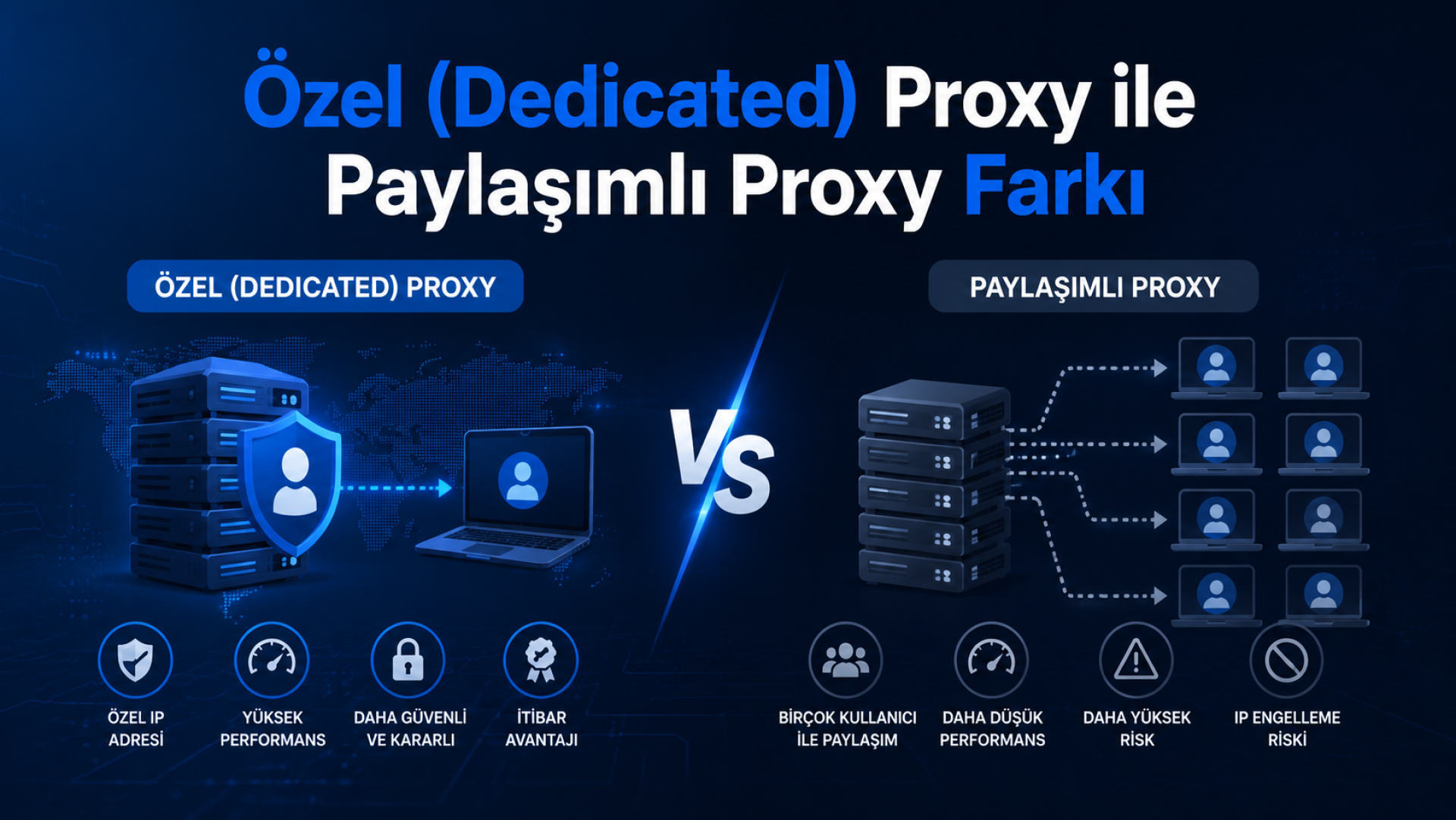
A proxy is an intermediate layer that routes a user's internet traffic through the IP address of an intermediary server instead of the user's own IP. A dedicated proxy is a model in which a single IP address is allocated to only one user. A shared proxy is a model in which the same IP address is used by multiple users at the same time. LivaProxy is a proxy service provider that offers both approaches over its Turkey based infrastructure (LIVAPROXY YAZILIM TİCARET LİMİTED ŞİRKETİ, Sultangazi / İstanbul, Trade Registry No 43944, established in İstanbul). The main distinction between the two models comes down to the balance between cost and IP reputation (how trustworthy an IP address is seen by other services).
The dedicated and shared distinction is an allocation model that is independent of IP type (mobile, data center, ISP, IPv6). That is, the same mobile proxy can be assigned exclusively to one user or shared among multiple users. In the LivaProxy catalog, data center IPv4 proxy starts at 50 TL, ISP IPv4 proxy starts at 100 TL, and monthly mobile proxy starts at 1,400 TL/month (Economy 15GB). This price difference is largely explained by the resource cost created by the allocation model.
The main difference is whether an IP address is assigned to a single user or to multiple users. In a dedicated proxy, the IP address is tied to a single account only, so the reputation of that IP depends entirely on the behavior of one user. In a shared proxy, another person using the same IP for spam, excessive requests, or rule violations raises the risk of the IP being blacklisted for all users. This structural distinction has a direct effect on speed, stability, and cost.
The second critical difference is bandwidth sharing. Bandwidth is the measure that expresses the amount of data a connection can carry per unit of time. In a dedicated proxy, the entire capacity is reserved for one user; in a shared proxy, the same capacity is divided among concurrent users, which leads to longer response times during peak hours. The third difference is session control: with a dedicated IP, session duration and IP reset are entirely under the user's control.
In the dedicated model, IP allocation is locked to a single account, and the reputation history remains traceable. In the shared model, the IP pool rotates among multiple users, so the past usage of an IP is not transparent to the user. LivaProxy mobile proxy packages include IP authorization (whitelist, meaning access only from permitted IPs), manual IP reset, and automatic IP reset features; these controls make it easier to manage IP reputation in dedicated use.
Cost is higher in a dedicated proxy because a single user bears the entire IP and bandwidth resource. In a shared proxy, the same resource is divided among multiple users, so the unit cost drops. The LivaProxy price range stretches from the 50 TL level for data center IPv4 to the 4,250 TL level for /32 subnet IPv6 proxy server, which covers both low budget testing needs and intensive enterprise use.
The comparison is made on four axes: IP allocation, performance, IP reputation, and cost. The table below summarizes the behavior of the two models on these axes. The values in the table are the structural outcomes of the allocation model and are independent of IP type (mobile, data center, ISP).
The table shows that the two models are not opposites but complements: low cost and low risk scenarios point to the shared model, and scenarios where stability and IP reputation are critical point to the dedicated model.
A dedicated proxy is suited for use cases where IP reputation must stay consistent. Users managing social media accounts want to connect from the same trusted IP every session; a shared IP being blocked because of another user puts account security at risk. Automation and bot driven workflows also need stable sessions. LivaProxy mobile proxy packages support HTTP/HTTPS and SOCKS5 protocols, which allows integration with different software in dedicated use. In Turkey based services, the packages are designed for these scenarios that require continuous and stable single user allocation.
Typical user profiles that lean toward dedicated proxy include:
Social media managers: stable IP mapping for each account in multi account management.
Data collection and web scraping teams: long running, uninterrupted crawl jobs that require continuous sessions.
Gaming and region locked content users: consistent Turkey IP requirement.
Enterprise automation: predictable IP behavior in API integrations.
A shared proxy is preferred for jobs where cost is the priority and IP reputation is not critical. In one off data pulls, general accessibility tests, or short term trial scenarios, sharing an IP with other users is an acceptable trade off. LivaProxy's daily mobile proxy starts at 225 TL and weekly mobile proxy starts at 700 TL; these short term packages provide an entry level option suited for testing needs that do not require continuous allocation.
The limit of the shared model is the performance fluctuation during peak hours and the blocking risk arising from the behavior of other users. For this reason, sensitive account operations, payment verification flows, and automations that require long running sessions are not recommended on the shared model.
IP type and allocation model are two separate layers and are chosen independently of each other. Mobile proxy provides a real mobile IP over carrier infrastructure and can be offered both dedicated and pool based. Data center proxy uses a data center IP and is generally the lowest cost option. ISP proxy combines data center speed with mobile like reputation through an internet service provider IP. IPv6 proxy starts at 200 TL, and rotating IPv6 proxy starts at 1,250 TL; the LivaProxy catalog hosts all of these layers.
The table shows that price depends on both IP type and duration: the same mobile IP is offered in different packages over durations extending from daily to monthly.
The choice is based on the answers to three questions: is IP reputation critical for you, how tight is the budget, and how long is the session? If IP reputation is critical and the session is long, the dedicated model stands out, because the blocking risk reduces to a single source of behavior. If budget is the priority and the job is one off, the shared model provides a cost advantage. Because the LivaProxy price range stretches from 50 TL to 4,250 TL, both directions can be met under a single provider, which makes the transition from the test phase to enterprise scale easier.
Three practical decision notes: first, in multi account social media management, the shared IP's common blocking risk lowers account security, so dedicated is preferred in this scenario. Second, in a short term crawl test, the daily mobile package brings cost down compared to a monthly package. Third, in region locked jobs that require a Turkey location, the location should be verified before the IP type; LivaProxy leaves this control to the user through IP authorization and automatic IP reset.
This content is for informational purposes. The prices, scope, and features of proxy packages may change; verify current information from the official seller page before purchase.
The difference is the allocation model of an IP address. In a dedicated proxy, the IP address is assigned to a single user, and reputation control rests entirely with that user. In a shared proxy, the same IP is used among multiple users, which lowers the cost but raises the blocking risk caused by shared behavior.
A dedicated proxy is more expensive because the entire IP address and bandwidth capacity is reserved for a single user. In the shared model, the same resource is divided among multiple users, so the unit cost drops. In the LivaProxy catalog, data center IPv4 proxy starts at 50 TL, while monthly mobile packages start at 1,400 TL/month.
A shared proxy is suited for testing and broad crawling work where IP reputation is not critical. However, a violation by another person using the same IP can cause the IP to be blocked for all users. The dedicated model carries lower risk for work that requires account security and long running sessions.
A mobile proxy can be offered both dedicated and shared, because the allocation model is independent of IP type. LivaProxy mobile proxy packages provide a Turkey based IP over carrier infrastructure and include IP authorization, manual, and automatic IP reset features. These controls make it easier to manage IP reputation in dedicated use.
A dedicated proxy is suited for social media account management. Connecting each account from a stable IP owned by a single user removes the risk of the shared IP being blocked because of another user. HTTP/HTTPS and SOCKS5 protocol support allows integration with multi account management tools.