Sign In
Sign Up
Select Your Country
 Turkey (Türkçe)
 Worldwide (English)
Turkey (Türkçe)
Worldwide (English)
Turkey (Türkçe)
Worldwide (English)
Worldwide (English)
Turkey (Türkçe)
Worldwide (English)
Turkey (Türkçe)
Worldwide (English)
 WELCOME Kupon Kodunu Kullanarak İlk Siparişlerinize Özel %10 İndirim İmkanından Faydalanabilirsiniz.
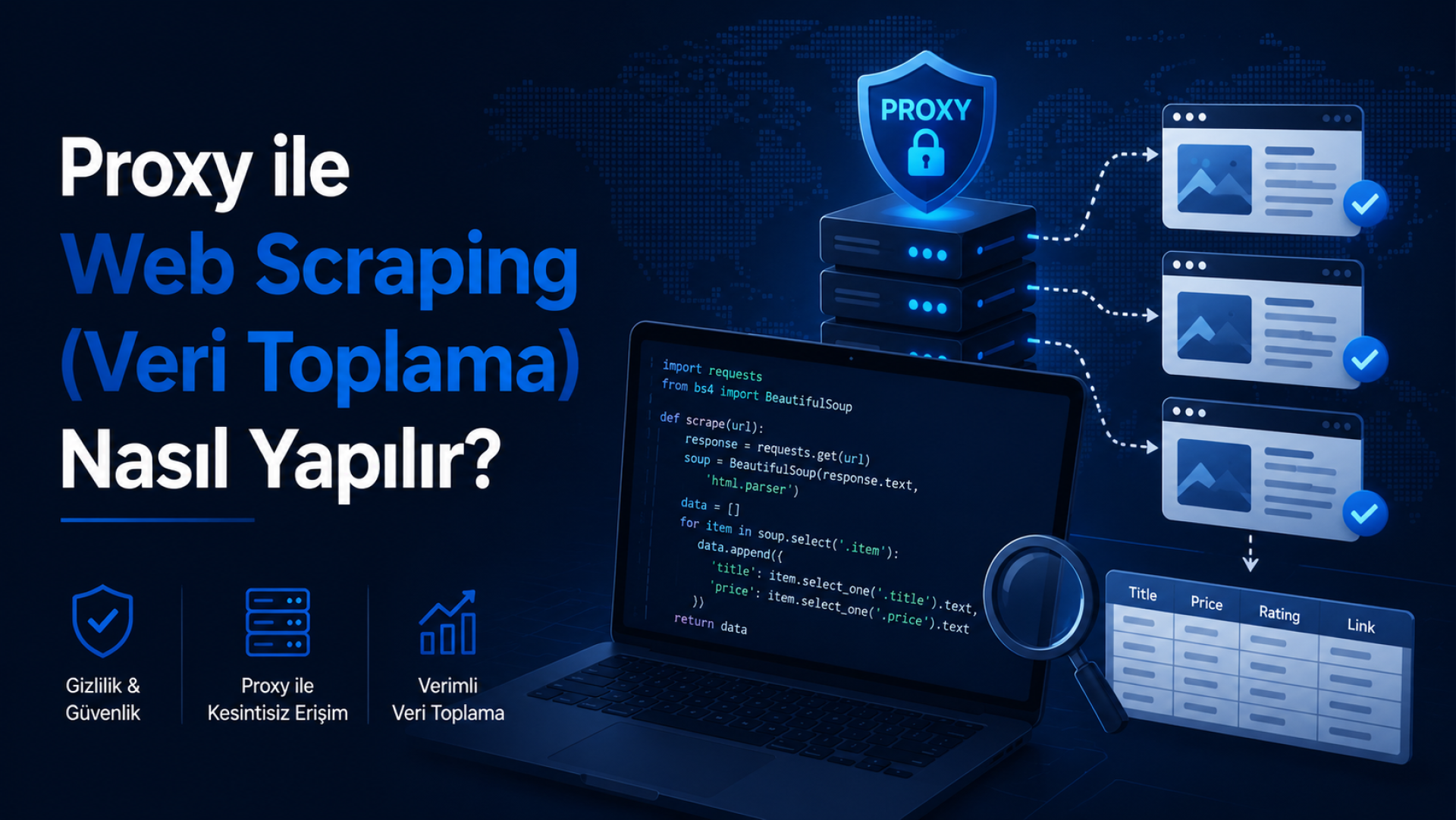
Web scraping with a proxy is the method of automatically collecting publicly available data on the internet through an intermediary server (proxy). Web scraping, or data collection, is the practice of software reading web pages and turning certain fields into structured data. A proxy is an intermediary server that forwards the request through its own IP address. LivaProxy offers a Turkey based mobile proxy service for these operations; monthly mobile proxy packages start at 1,400 TL with 15GB of traffic. The service supports HTTP/HTTPS and SOCKS5 protocols and is run with the 0850 309 4810 support line.
Web scraping consists of two technical layers. The first layer is the request, meaning pulling the target page from the server. The second layer is parsing, meaning selecting the desired fields from the returned HTML content. The proxy fits into the first layer of this chain and reduces the blocking of heavy traffic coming from a single IP by masking the real location that sent the request.
In the web scraping process, a proxy serves to distribute access blocks triggered by excessive requests from a single address. Software sending many requests per second from a single IP is automatically flagged as a bot by the target server and is usually stopped with a 429 or 403 response code. A proxy pool spreads the requests across different addresses and makes each request appear more natural.
A mobile proxy, because it exits through carrier infrastructure, is the type that performs this distribution in the most realistic way. LivaProxy provides mobile proxy through partnerships with Turkey's leading carrier companies (brand statement). A Turkey based IP is decisive for the correct collection of pages that can only be accessed from the local network (for example, sites that show TR specific prices or content).
IP management is also part of this function. LivaProxy packages come with IP authorization (whitelist), manual IP reset, and automatic IP reset features. IP reset refreshes the exit address in use; in long running collection jobs, this prevents wear on the same address.
Proxy type is chosen based on the sensitivity of the data to be collected and the budget. The LivaProxy catalog has a wide range from datacenter IPv4 proxy starting at 50 TL to /32 subnet IPv6 proxy server starting at 4,250 TL. Datacenter proxy is economical in low sensitivity bulk jobs; on sites with low blocking tolerance, mobile proxy is more durable.
The table below summarizes LivaProxy proxy types with verified starting prices and typical data collection use cases.
In large scale jobs where the address must change on every request, the type provides renewing IP behavior at a starting price of 1,250 TL. In jobs that require a stable session (for example, a collection that follows multiple steps on the same page), packages with static IPs are preferred.
Web scraping with a proxy is built on compliance with the target site's terms of use and the principle of staying limited to publicly available data. The ordered steps below define the flow from purchasing a proxy in the service panel to data parsing. The steps are arranged according to the LivaProxy panel structure (WiseCP based membership and panel).
Read the target site's robots.txt file and terms of use; collection is limited to permitted areas and publicly available data.
Create an account in the LivaProxy panel and sign in (create account and sign in steps).
Choose the proxy type based on data sensitivity: datacenter for economical bulk jobs, mobile proxy for jobs with low blocking tolerance.
After purchasing the package, define your own server address with IP authorization (whitelist) from the panel.
Enter the proxy connection information (host, port, protocol) into your software; use HTTP/HTTPS or SOCKS5 depending on which is suitable for your job.
In the collection software, add a delay (rate limit) to the request interval; keep the number of requests per second at a level that does not strain the server.
In long jobs, enable the automatic IP reset feature; this ensures the exit address is renewed regularly.
Parse the incoming HTML content and turn only the fields you need into structured data (for example, a table or JSON).
If the data you collect contains personal data, evaluate it within the scope of KVKK (Personal Data Protection Law) and avoid storing unnecessary personal data.
Web scraping is a legitimate data collection method as long as it stays limited to publicly available data and the target site's terms of use. The legal framework depends on the type of data collected and the conditions of the source. Content behind a login wall, copyrighted material, or personal data require separate permission and compliance.
The items below are the main limits observed in responsible data collection:
Compliance with robots.txt rules and the site's terms of use is ensured.
Request speed is kept at an interval that does not burden the target server.
If personal data is being collected, KVKK and the related EU regulation GDPR framework are considered.
Content that requires login or is paid is not collected without explicit permission.
Collected data is not used outside the purpose permitted by the source.
Proxy use does not replace these limits. A proxy provides the technical distribution of the request; the legal compliance of the collection activity is the user's responsibility. LivaProxy offers this technical layer with its Turkey based infrastructure; the content decision remains with the user.
The most common mistake in web scraping with a proxy is sending high volume requests from a single IP without adding a delay to the request interval; this behavior speeds up access blocking. The second common mistake is choosing a proxy type that does not match data sensitivity: using a 50 TL entry datacenter proxy on a site with low blocking tolerance leads to being blocked quickly, and mobile proxy is more durable for these jobs.
The third mistake is never using the IP reset feature; in long jobs, the same exit address wears out. Automatic IP reset in LivaProxy packages reduces this wear. The fourth mistake is starting collection without reading the target site's terms of use and robots.txt file; this creates both legal risk and a technical obstacle. The fifth mistake is storing personal data without evaluating the KVKK framework.
This content is for informational purposes and does not replace legal advice. Before data collection activity, verify the target site's terms of use and your KVKK and GDPR obligations from authoritative sources.
Web scraping with a proxy is the collection of publicly available data through a proxy while complying with the target site's terms of use. First, a proxy is purchased from the panel, IP authorization is configured, connection information is entered into the software, and a delay is added to requests. The incoming HTML content is parsed, and only the necessary fields are turned into structured data.
The proxy type is chosen based on the sensitivity of the data. For low protection bulk jobs, datacenter IPv4 proxy starting at 50 TL is sufficient. On sites with low blocking tolerance, a mobile proxy is more durable; the LivaProxy monthly mobile proxy package starts at 1,400 TL with 15GB of traffic.
Web scraping time depends on the number of pages to be collected and the delay added to requests. While one off small jobs can be completed in minutes, large scale collections can take hours. Adding a delay to the request interval to avoid loading the server extends the time but lowers the risk of being blocked.
The most common issue is the access block triggered by high volume requests from a single IP; the server returns a 429 or 403 code. A proxy pool and IP reset reduce this block. Other issues are parsing that breaks when the page structure changes and choosing a proxy type that does not match data sensitivity.
For advanced data collection, rotating proxy that changes the address on every request and automatic IP reset features are used. LivaProxy rotating IPv6 proxy starts at 1,250 TL and provides a different IP on every request. In large scale jobs, request speed management, session control, and KVKK compliance are the priority technical settings.